Trying to choose between a townhome and a single-family home in Fairfax, VA? You are not alone. Each option offers a distinct lifestyle, cost profile, and level of maintenance. In this guide, you will learn how prices, space, outdoor areas, HOAs, financing, insurance, and taxes compare so you can make a confident choice. Let’s dive in.
Fairfax market snapshot
Fairfax County’s overall median sale price sits in the mid-$700,000s. Recent county data places the median around $723,000 as of February 2026, which aligns with other sources showing a similar trend. You can review the latest county snapshot on Redfin’s Fairfax County page for current numbers and examples of recent sales (county market overview). Realtor.com also reports a comparable county median and highlights how prices vary widely by neighborhood (Fairfax County market overview).
As a rule of thumb, that county median often falls between typical townhome and single-family tiers. Townhomes in Fairfax commonly range from the mid-$400,000s to the upper-$800,000s or $900,000s in closer-in or newer communities, while many single-family homes in desirable neighborhoods start in the high-$800,000s and run into the $1M-plus range. Forecasts from NVAR/GMU call for modest price growth and steady demand for attached housing given its relative affordability (NVAR Fairfax forecast).
Space and layout
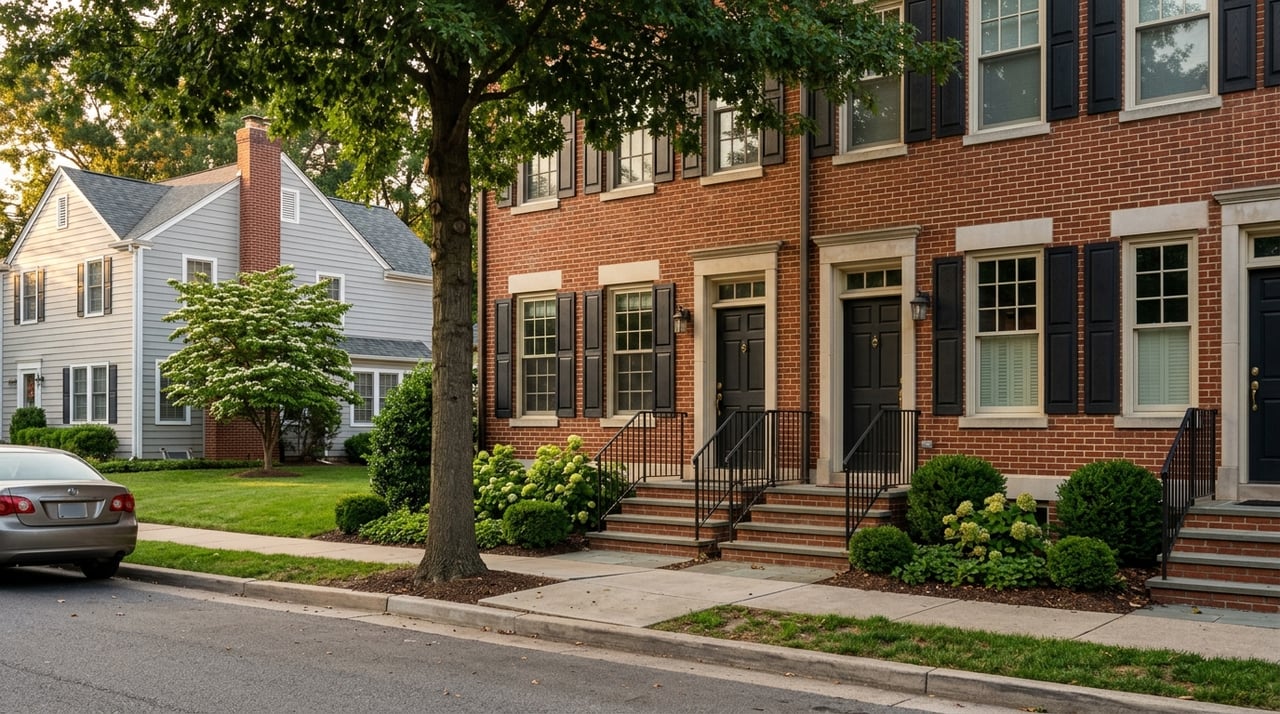
Townhomes maximize interior square footage on a compact footprint. You typically get 2 to 4 levels, with bedrooms above the main living and kitchen areas, and sometimes an attached garage. Storage may be tighter than in a detached home, but day-to-day living can feel efficient.
Single-family homes usually offer larger footprints, more flexible floor plans, and easier single-level access to living areas. If you want wide, contiguous spaces or plan for multi-generational living, detached layouts often deliver that flexibility. For a quick primer on how townhomes differ from other property types, see this straightforward overview (townhouse basics).
Outdoor areas and privacy
If a large private yard is a must-have, single-family homes are more likely to fit. Many Fairfax detached properties sit on lots ranging from roughly 0.1 to 0.5 acres or more, depending on the neighborhood. That scale supports gardens, play space, pets, and potential additions or outdoor structures, subject to local regulations.
Townhomes often trade lot size for location and convenience. You may see a small fenced yard, patio, or rooftop deck. For buyers who prioritize walkability, shorter commutes, and less yard work, that can be a welcome exchange. The key is to align your outdoor wish list with your daily routines and maintenance preferences.
Maintenance and HOA costs
For most townhomes with an HOA, exterior elements and shared spaces are maintained by the association. Typical coverage includes common-area landscaping, snow removal on private roads or paths, exterior upkeep where specified, amenity maintenance, management costs, liability insurance for common areas, and reserve contributions. That simplifies your weekend to-do list, but it adds a monthly fee and rules for exterior changes. Realtor.com’s national research places the median HOA fee near $135 per month, though Fairfax communities vary widely based on amenities and scope (HOA research and fee context).
Single-family homeowners without an HOA handle exterior maintenance themselves. You will plan and budget for roof, siding, lawn care, driveway upkeep, and tree work. Some single-family neighborhoods do have associations, and their coverage ranges from basic common-area care to full amenity sets. Always verify what your fee includes in writing.
Reserve funding matters. If an HOA’s reserves are thin, owners may face special assessments to cover capital projects or large insurance deductibles. Reviewing budgets, reserve studies, and board minutes helps you spot risks before you buy.
HOA structure and Virginia legal basics
Virginia’s common-interest communities are governed by statutes in Title 55.1 of the Code of Virginia. When you are under contract on a home with an HOA or condo association, you will receive a disclosure packet with governing documents, financials, insurance details, and other required items. Read everything closely, and do not hesitate to ask questions about coverage, rules, and any signs of deferred maintenance or litigation. You can reference the statutes directly in the state code (Virginia Code Title 55.1).
What to request and review:
- Governing documents: declaration/CC&Rs, bylaws, rules, architectural guidelines
- Current budget, most recent reserve study, and last audited or compiled financials
- Recent board meeting minutes and any special assessment history
- Litigation disclosures and details of the master insurance policy, including deductibles and what is covered
Financing differences you should know
How a property is titled affects financing. Many townhomes are fee-simple, which is underwritten more like a single-family home. Others are condo-titled, where lenders evaluate the entire project. For condominium properties, lenders typically look at owner-occupancy levels, reserves, litigation, and the annual budget. If a project is not warrantable under Fannie Mae, Freddie Mac, FHA, or VA guidelines, your loan options may be limited or may require larger down payments or rate adjustments. Ask your lender early whether a target townhome is fee-simple or condo-titled and confirm the project’s warrantability (condo warrantability guide).
Insurance, taxes, and your monthly budget
Insurance varies by property type. Condo-titled units generally pair an association master policy with an individual HO-6 condo policy that covers interior finishes, belongings, and liability. Single-family homes typically use an HO-3 policy that insures the entire structure and detached buildings. For condos, consider loss-assessment coverage, which can help with large master-policy deductibles that are passed to owners (what HO-6 covers).
Property taxes are set by the county rate and your home’s assessed value. Fairfax County’s adopted real estate tax rate for FY 2026 was about $1.1225 per $100 of assessed value. Using the recent county median sale price of roughly $723,000 as a simple example: 723,000 ÷ 100 × 1.1225 ≈ $8,100 per year. Always confirm the current adopted rate in the county budget and use your specific assessment for accurate planning (Fairfax County FY2026 Budget Overview). For the latest market median referenced, see the Fairfax County page above (county market overview).
To build a realistic monthly budget, include mortgage principal and interest, property taxes, homeowners insurance, HOA dues if applicable, estimated utilities, and a maintenance reserve. Townhomes may have slightly lower utilities thanks to shared walls, while single-family homes usually require higher maintenance reserves due to full exterior responsibility.
Which is right for you?
Choose a Fairfax townhome if you want:
- Lower exterior maintenance with HOA support
- A walkable location near shops, parks, or Metro
- Efficient multi-level layouts and potential garage parking
Choose a Fairfax single-family home if you want:
- A larger private yard and outdoor flexibility
- More contiguous interior space for gatherings or multigenerational needs
- Greater control over exterior changes without as many HOA rules
Quick Fairfax buyer checklist
Use this short list to compare options and de-risk your decision:
Map your full monthly budget. Include mortgage, taxes, insurance, HOA dues, utilities, and a maintenance reserve. Use current local medians or neighborhood comps for estimates.
Confirm the title type. Ask whether the property is fee-simple or condo-titled, and if condo, whether it is warrantable under conventional, FHA, or VA standards.
Review the HOA packet. Read CC&Rs, bylaws, budget, reserve study, last 12 months of minutes, and any litigation disclosures. Look for reserve shortfalls and recent assessments.
Verify what dues cover. Clarify services like roof, siding, trash, snow removal, water, and master insurance. Confirm responsibility for exclusive-use spaces like yards or parking.
Set the right insurance. Ask an insurance agent whether HO-6 or HO-3 applies and whether loss-assessment coverage is advisable.
Compare neighborhood comps. Pull 3 to 5 recent sales for both townhomes and single-family homes in your target zip code to see the real price gap on the blocks you prefer.
Next steps
Every Fairfax block has its own story. If you want data-backed guidance, clear comparisons, and on-the-ground insight, let’s talk. Reach out to Francisco Hoyos to line up neighborhood comps, inspect HOA documents together, and build a smart path to your next home.
FAQs
How do Fairfax townhome prices compare to single-family homes in 2026?
- County data shows a median sale price in the mid-$700,000s, with many townhomes starting in the mid-$400,000s and many single-family homes in desirable areas starting in the high-$800,000s to $1M-plus, depending on neighborhood.
What do typical HOA fees cover in Fairfax townhome communities?
- Common coverage includes exterior and common-area maintenance, landscaping, snow removal on private roads, amenities, management, liability insurance for common areas, and reserves; exact inclusions vary by community.
Are most Fairfax townhomes fee-simple or condo-titled, and why does it matter?
- Many are fee-simple, but some are condo-titled; condo-titled properties require project-level lender reviews that can affect loan options, rates, and down payment requirements.
How should I estimate Fairfax property taxes when comparing homes?
- Multiply the assessed value by the county rate per $100 of value; for FY 2026 the rate was about $1.1225 per $100, but always confirm the current adopted rate and your specific assessment.
Which insurance policy applies to my home type in Fairfax?
- Condo-titled homes pair an association master policy with an individual HO-6 policy, while single-family homes generally use an HO-3 policy that covers the full structure and detached buildings.
What maintenance should I plan for with a Fairfax single-family home?
- Budget for roof, siding, gutters, lawn and tree care, driveway, and exterior painting or repairs, plus routine systems maintenance for HVAC, water heater, and appliances.